Author: Luckybrother
ODISHA, May 11, 2026 — India has achieved a “Powerhouse” milestone in its strategic defense capabilities by successfully conducting the second major flight test of the Agni-5 missile equipped with Multiple Independently Targetable Re-entry Vehicle (MIRV) technology.
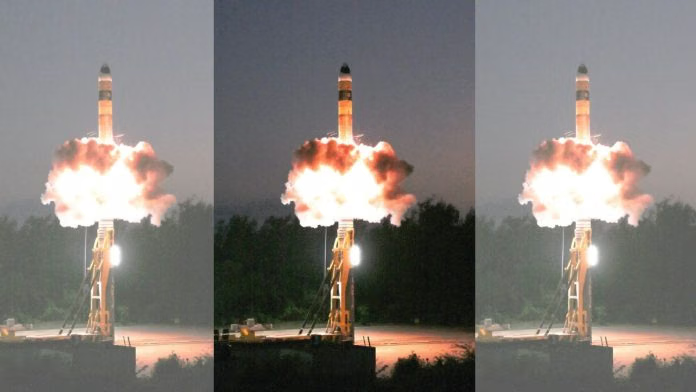
The test, conducted on Friday, May 8, 2026, from the Dr. APJ Abdul Kalam Island off the coast of Odisha, was carried out under the code name Mission Divyastra (Divine Weapon). This high-stakes trial, executed jointly by the Defence Research and Development Organisation (DRDO) and the Strategic Forces Command (SFC), confirms India’s entry into a very exclusive club of nations possessing the ability to strike multiple targets with a single intercontinental-capable platform.
ALSO READ : HYBE India Pop-Up Park: K-Pop Wave Hits Hyderabad with Exclusive Fan Experience on May 23
The Breakthrough: What is MIRV Technology?
In traditional ballistic missiles, one missile carries one warhead to one target. A MIRV-capable missile, however, changes the equation of nuclear deterrence entirely.
- How it Works: The Agni-5 now carries a payload of multiple nuclear warheads (reportedly 3 to 4 in current tests). These warheads separate in the mid-course phase of flight and re-enter the atmosphere independently.
- Independent Targeting: Each warhead can be assigned to a different target spatially distributed over a large geographical area—separated by hundreds of kilometers—allowing a single launch to neutralize multiple strategic sites simultaneously.
- Overwhelming Defenses: By launching multiple warheads from a single platform, the missile can effectively overwhelm an adversary’s Ballistic Missile Defence (BMD) systems, making interception nearly impossible.
Mission Divyastra: Key Performance Data
The Ministry of Defence confirmed that the flight trial met all mission objectives. Telemetry and tracking data from multiple ground and ship-based stations in the Indian Ocean Region validated the operational trajectory.
| Feature | Agni-5 (Advanced Variant) Details |
| Operational Range | Over 5,000 km (extendable to ICBM ranges) |
| Payload | Multiple Nuclear Warheads (MIRV) |
| Speed | Terminal phase velocity up to Mach 24 |
| Propulsion | Three-stage solid-fueled rocket |
| Mobility | Road-mobile and Canister-launched (Rapid readiness) |
The use of nanotechnology-enabled miniaturization was a critical “Powerhouse” factor in this success, allowing DRDO to pack multiple sophisticated warheads into the missile’s nose cone without compromising its range.
Strategic Significance: Joining the Global Elite
With the successful validation of Mission Divyastra, India officially joins a select group of nations—including the United States, Russia, China, France, and the United Kingdom—that possess operational MIRV capability.
The “Powerhouse” Impacts on National Security:
- Credible Second-Strike Capability: India maintains a ‘No First Use’ (NFU) nuclear policy. MIRV technology ensures that even if India is struck first, its retaliatory strike will be credible and capable of bypassing any sophisticated enemy shields.
- Strategic Signaling: The test sends a clear signal across the Indo-Pacific. With a range exceeding 5,000 km, the Agni-5 can reach any target deep within the Eurasian landmass, including northern China and beyond.
- Efficiency: One MIRVed missile can achieve what previously required three or four separate missile launches, providing a more cost-effective and survivable deterrent.
Lesson to Learn: The Evolution of “Minimum Deterrence”
The successful test of the advanced Agni-5 marks a shift in India’s strategic posture. For years, India followed a policy of “Credible Minimum Deterrence.” As regional adversaries continue to develop layered missile defenses (like China’s HQ-19) and hypersonic weapons, India has evolved its “minimum” to include these high-tech capabilities.
The lesson for regional stability is clear: technological parity is essential for peace. By developing the Agni-5 MIRV, India isn’t seeking aggression but is ensuring that the “cost of conflict” remains too high for any potential aggressor to consider.
Frequently Asked Questions (FAQ)
1. Is Agni-5 an Intercontinental Ballistic Missile (ICBM)?
Officially, India classifies Agni-5 as an Intermediate-Range Ballistic Missile (IRBM) with a range of over 5,000 km. However, global experts note that its range and three-stage solid-fuel design place it at the threshold of ICBM capability (5,500+ km).
2. What is the status of Agni-6?
DRDO Chairman Samir V. Kamat confirmed in April 2026 that the design phase of Agni-6 is complete. Agni-VI is expected to have a range of 10,000–12,000 km and will incorporate even more advanced MIRV and MaRV (Maneuverable Re-entry Vehicle) technology.
3. What does “Canister-launched” mean?
It means the missile is stored in a sealed, climate-controlled tube. This protects the missile from the elements, allows for easier transport on a road-mobile launcher, and enables a “Fire and Forget” launch within minutes of receiving orders.
4. Why is it called “Mission Divyastra”?
The name is derived from Sanskrit, meaning “Divine Weapon.” It reflects the indigenous pride and the sophisticated nature of the MIRV technology developed by Indian scientists.
Final Thoughts: A New Era of Indian Deterrence
Mission Divyastra is a “Powerhouse” testament to India’s growing prowess in orbital mechanics and missile engineering. By successfully testing the Agni-5 with MIRV technology, India has significantly fortified its national security architecture, ensuring it remains a stabilizing power in a rapidly changing global landscape.
Do you think India’s shift toward visible “MIRV Deterrence” will lead to a more stable Indo-Pacific? Share your thoughts on national defense in the comment box below!


- Prince George Poses in Sharp Suit for Official Birthday Photo as He Turns 13: Royal Lineage, Family Ties & Growing Future King Role
- Wetherspoons Issues Fourth Profit Warning in Seven Months as Rising Operating Costs and Shift in Consumer Spending Bite
- Our Hearts Are Crushed’: Hannah Rapp’s Violent Death Sparks Outpouring of Grief Across Sports World
- Former Southern Water Employees to Face Trial Over Alleged Cover-Up in Wastewater Testing; Ex-CEO Matthew Wright Named
- HMDA Launches Major Road Widening Drive: Key Corridors Around HITEC City, PVNR Expressway & KBR Park Set for Urgent Upgrades


 By
By




![Sun Pharma’s $11.75 Billion Organon Acquisition: A New Titan in the Top 25[2026]](https://sparkchronicle.com/wp-content/uploads/2026/04/Gemini_Generated_Image_hnub3xhnub3xhnub.png)