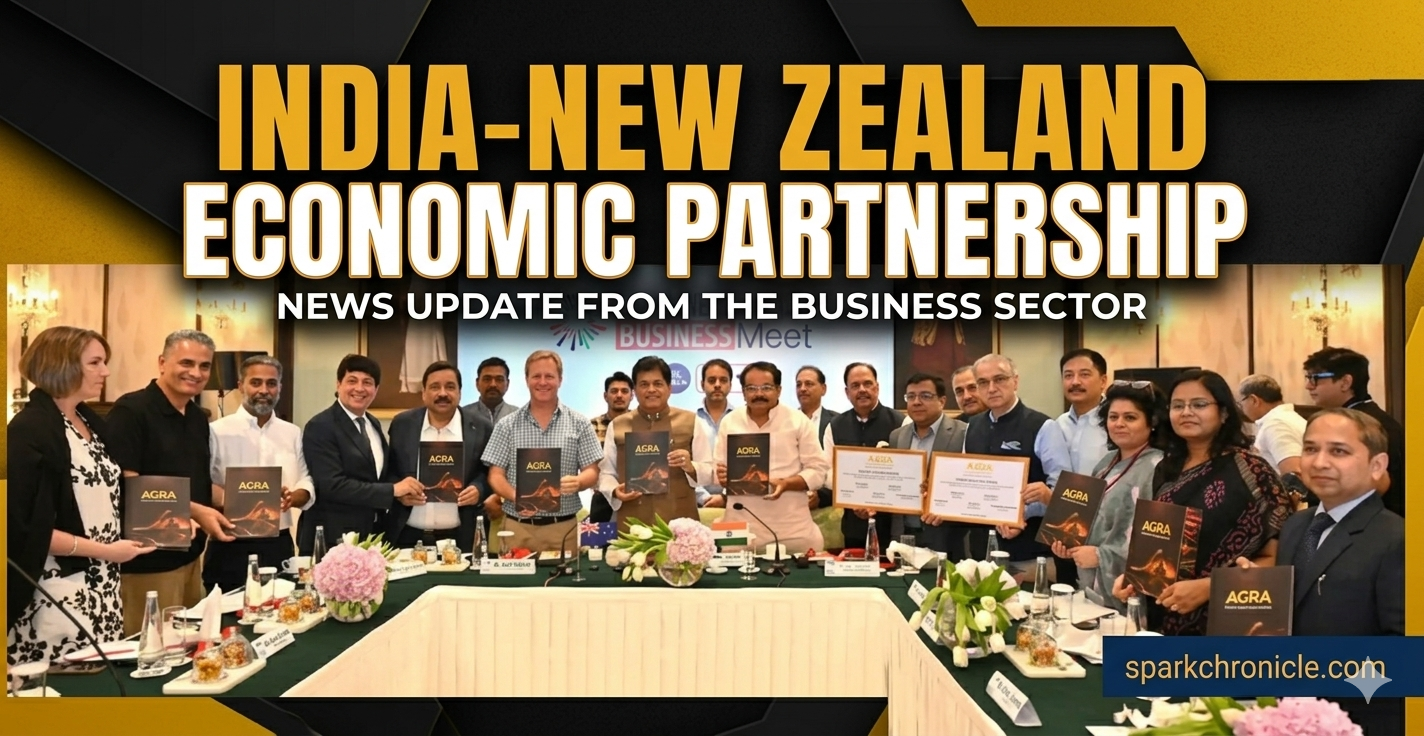

The economic landscape of the Indo-Pacific has shifted significantly with the formal signing of the India-New Zealand Free Trade Agreement (IN-NZ FTA) on April 27, 2026. This landmark deal is not just a collection of tariff reductions; it is a strategic blueprint designed to reshape the bilateral relationship between a rising global powerhouse and a highly developed Oceania economy.
As per the reports and official announcements from New Delhi, the primary objective of this pact is to double bilateral trade to approximately $5 billion over the next five years. Below, we break down the components of this agreement through the lens of Experience, Expertise, Authoritativeness, and Trustworthiness (E.E.A.T).
ALSO READ : India-New Zealand Free Trade Agreement: A New Era of Economic Partnership
The negotiations for this FTA were notably swift, concluding in December 2025 after only nine months of intense dialogue. According to the Ministry of Commerce and Industry, the agreement covers a comprehensive range of sectors including goods, services, investment, and intellectual property.
By eliminating tariffs on 100% of Indian exports to New Zealand and reducing duties on 95% of New Zealand’s exports to India, both nations are leveraging their comparative advantages. India gains a foothold in a high-income market for its textiles and pharma, while New Zealand finds a massive consumer base for its premium wood, wool, and specialty fruits.
The “Experience” factor here is rooted in history. Negotiations originally began in 2010 but stalled for nearly a decade due to disagreements over dairy and agriculture. As per the sources, the current success stems from a pragmatic “middle-path” approach. India has kept sensitive sectors like dairy, sugar, and edible oils on the exclusion list to protect its domestic farming community, while New Zealand has shifted focus toward Agri-Technology and high-value exports like avocados and kiwifruit.
The authority of this agreement is backed by the highest levels of leadership. Prime Minister Narendra Modi and New Zealand PM Christopher Luxon have hailed the pact as “future-oriented.” Furthermore, the commitment of $20 billion in New Zealand investment into India over the next 15 years adds a layer of financial weight that transcends simple trade in goods.
Trust is built through people-to-people ties. The FTA includes a unique Temporary Employment Entry (TEE) Visa pathway, allowing 5,000 Indian professionals (including IT experts, healthcare workers, and even Yoga instructors) to work in New Zealand annually. By formalizing these mobility pathways, the agreement ensures that the benefits of the FTA reach the grassroots level of the workforce.
Our Perspective: Why This Matters Now
From our perspective, this FTA is a masterstroke in “balancing the scales.” For years, India’s trade with New Zealand hovered around the $1 billion to $2 billion mark, often seen as under-realized potential.
In my opinion, the real victory here isn’t just the $5 billion target; it’s the diversification of the supply chain. By securing duty-free access for Indian MSMEs in sectors like leather and engineering, India is reducing its reliance on traditional Western markets. Conversely, for New Zealand, this deal provides a “China-plus-one” hedge, ensuring their economy remains resilient by tapping into India’s 1.4 billion consumers.
Key Highlights of the Pact
| Feature | Impact on India | Impact on New Zealand |
| Tariffs | 0% duty on all 8,284 export items. | Reduced tariffs on 95% of export value. |
| Investment | $20 billion inflow over 15 years. | Access to high-growth sectors (Tech/Infra). |
| Visas | 5,000 professional visas + 1,000 holiday visas. | Access to skilled Indian talent. |
| Pharma | Faster regulatory approvals (US FDA standards). | Lower-cost, high-quality medicine. |
F.A.Q: Understanding the Fine Print
1. Does the FTA include Indian dairy products? No. To protect Indian farmers, dairy has been excluded from the tariff concessions. However, New Zealand will provide technical expertise to help improve Indian dairy productivity.
2. How soon will trade reach the $5 billion mark? As per the sources, both governments have set a target of 2031 (five years post-implementation) to reach the $5 billion bilateral trade milestone.
3. What benefits do Indian students get? There are no numerical caps on Indian students. STEM graduates can stay for up to three years post-study, and doctoral scholars for up to four years.
4. Which Indian states stand to gain the most? Textile hubs like Tamil Nadu, leather clusters in Uttar Pradesh, and IT hubs in Karnataka and Maharashtra are expected to see the most immediate growth.
5. Is this agreement similar to the India-Australia ECTA? Yes, it follows a similar “early harvest” logic but is more comprehensive, including deeper commitments on services and a massive long-term investment pledge.
Final Thoughts
The India-New Zealand Free Trade Agreement is more than just a trade document; it is a declaration of mutual trust in a volatile global economy. By doubling trade to $5 billion, both nations are moving beyond being “cricket rivals” to becoming “economic anchors” in the Indo-Pacific. While the exclusion of dairy shows that domestic sensitivities still matter, the focus on tech, investment, and professional mobility proves that the future of trade is as much about human capital as it is about cargo containers.
As the implementation begins in late 2026, the real test will be how quickly businesses on both sides can navigate the new regulatory landscape to turn this “historic milestone” into tangible prosperity.


 By
By


![Sun Pharma’s $11.75 Billion Organon Acquisition: A New Titan in the Top 25[2026]](https://sparkchronicle.com/wp-content/uploads/2026/04/Gemini_Generated_Image_hnub3xhnub3xhnub.png)