By Sam Khan
Published: May 17, 2026
Against a backdrop of escalating geopolitical friction and maritime instability in West Asia, Prime Minister Narendra Modi’s high-stakes diplomatic visit to the United Arab Emirates on Friday, May 15, 2026, has injected a powerful dose of confidence into regional and global markets. The whirlwind bilateral summit in Abu Dhabi has successfully signaled long-term economic resilience, securing multi-billion-dollar commitments that firmly anchor the India-UAE corridor against international shocks.
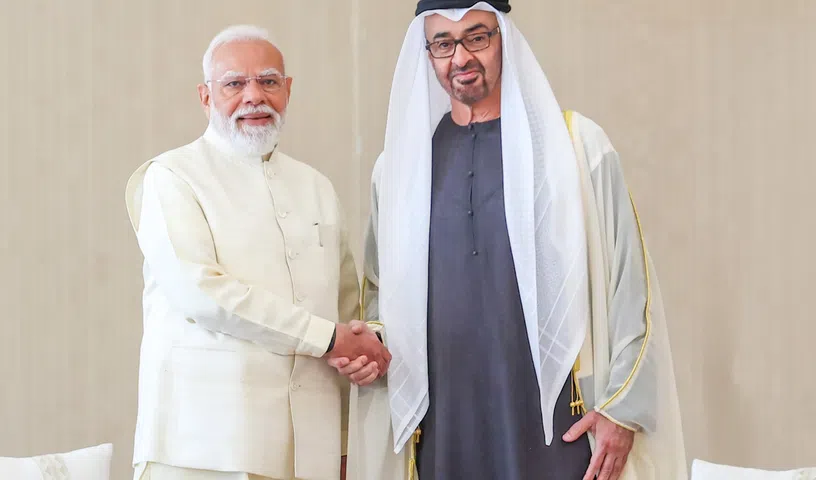
As the conflict involving regional powers threatens major trade corridors and energy shipping lines, global business leaders have heavily welcomed the joint declarations. The visit has effectively transformed severe geopolitical risk into an active framework for infrastructure, technology, and energy collaboration.
ALSO READ : 365 Days of Flavor: Bhukka Nawab Spotlights Tolichowki’s Viral ‘Miya Nawab’ Chicken Haleem
The Strategic Backdrop: De-escalation and Solidarity
The timing of the meeting carried deep strategic weight. Following recent targeted aerial strikes on the UAE amid the wider US-Israel-Iran conflict, the shipping channels of the Strait of Hormuz have faced ongoing operational blockades.
India-UAE 2026 Emergency Summit Blueprint:
• Strategic Alignment ──► Open Strait of Hormuz & Unimpeded Maritime Shipping
• Financial Anchors   ──► $5 Billion New Capital Commitment into Indian Entities
• Energy Expansion    ──► 30-Million-Barrel Strategic Petroleum Cooperation
In an explicit show of political trust, PM Modi used his opening remarks alongside UAE President Sheikh Mohamed bin Zayed Al Nahyan to condemn the security threats facing the Gulf nation, praising Abu Dhabi’s measured stance:
“We condemn the attacks on the UAE. The way the UAE has been targeted is not acceptable, but the way the leadership has handled the current situation with restraint is praiseworthy. India is prepared to extend all possible support to bring peace to West Asia.”
Turning Tensions into Tangible Assets: Key Breakthroughs
Rather than focusing strictly on crisis management, the diplomatic channels utilized the summit to execute concrete economic pacts, highlighted by a fresh $5 billion (USD) investment package into India.
1. Banking and Sovereign Wealth Expansions
The $5 billion injection features high-profile institutional transactions engineered to stabilize financial markets. Key financial entries include:
- A major stake acquisition by Emirates NBD Bank into India’s RBL Bank.
- Direct capital infusions by the Abu Dhabi Investment Authority (ADIA) into India’s National Infrastructure Investment Fund (NIIF).
- A major equity commitment by the International Holding Company (IHC) into Saman Capital.
2. Radical Energy Security Overhauls
With India importing roughly 87% of its crude oil, mitigating the risk of a Strait of Hormuz closure is an absolute economic priority. The summit formalized an agreement allowing the Abu Dhabi National Oil Company (ADNOC) to expand its crude stocks within the Indian Strategic Petroleum Reserves (ISPRL) to a massive 30 million barrels, alongside setting up dedicated strategic gas reserves on subcontinental soil.
3. Maritime and Air Defense Manufacturing
Recognizing the physical vulnerabilities of modern supply chains, the two nations signed a comprehensive Framework for Strategic Defence Partnership. This includes a major joint venture between Cochin Shipyard Limited and Dubai’s Drydocks World to establish an integrated ship repair cluster at Vadinar, India, ensuring maritime defense operations can be sustained domestically.
Corporate Leaders Applaud the Transnational Message
The proactive handling of the West Asian crisis has driven a massive surge in corporate sentiment. Paras Shahdadpuri, Chairman of the Dubai-headquartered Nikai Group, noted that the continued engagement provides an invaluable safety net for cross-border capital:
“For the business community, this continued engagement between both nations sends a very positive message. It reinforces a shared vision for growth, innovation, and long-term collaboration across trade, infrastructure, energy, and technology,” Shahdadpuri observed.
Similarly, Zubin Karkaria, Founder and CEO of VFS Global, highlighted the stabilizing nature of the partnership: “At a time of shifting geopolitical alignments and economic uncertainty, the agreements announced highlight how the partnership is evolving into a key pillar of regional and global stability.”
Final Thoughts
Prime Minister Modi’s brief but incredibly substantial stopover in Abu Dhabi proves that true strategic partnerships thrive in times of adversity. By anchoring their alliance with a $5 billion investment package, expanded maritime manufacturing corridors, and a massive 30-million-barrel strategic energy buffer, India and the UAE have built a resilient framework capable of withstanding severe international conflicts. This summit demonstrates a masterful execution of strategic autonomy, showing the global market that even when West Asian corridors face deep military friction, the economic pipeline connecting New Delhi and Abu Dhabi remains open, highly secure, and structurally sound.
Frequently Asked Questions (FAQs)
1. What was the core financial outcome of PM Modi’s UAE visit on May 15, 2026?
The UAE officially announced a major $5 billion (USD) investment commitment into the Indian economy, spanning banking acquisitions, sovereign wealth infrastructure funds, and private equity.
2. How are India and the UAE protecting energy lines against West Asia tensions?
The two countries signed agreements to increase UAE participation in Indian Strategic Petroleum Reserves to 30 million barrels, while establishing strategic gas buffers and long-term LPG supply security.
3. What stance did India take regarding the threats to the Strait of Hormuz?
PM Modi explicitly pushed for safe transit passage and unimpeded maritime navigation through the Strait of Hormuz, calling the channel vital for global energy security, food distribution, and macroeconomic stability.
4. What is the newly signed Strategic Defence Partnership?
It is a formal framework designed to deepen bilateral cooperation in defense manufacturing, cybersecurity, intelligence sharing, and maritime infrastructure, highlighted by a new ship repair cluster in Vadinar, India.
5. Why is this visit considered highly reassuring for international investors?
By locking in massive, long-term commercial and energy contracts during an active regional military crisis, both governments have demonstrated to global boards that their shared trade pipeline is heavily insulated from localized geopolitical shocks.


- Prince George Poses in Sharp Suit for Official Birthday Photo as He Turns 13: Royal Lineage, Family Ties & Growing Future King Role
- Wetherspoons Issues Fourth Profit Warning in Seven Months as Rising Operating Costs and Shift in Consumer Spending Bite
- Our Hearts Are Crushed’: Hannah Rapp’s Violent Death Sparks Outpouring of Grief Across Sports World
- Former Southern Water Employees to Face Trial Over Alleged Cover-Up in Wastewater Testing; Ex-CEO Matthew Wright Named
- HMDA Launches Major Road Widening Drive: Key Corridors Around HITEC City, PVNR Expressway & KBR Park Set for Urgent Upgrades


 By
By





![Sun Pharma’s $11.75 Billion Organon Acquisition: A New Titan in the Top 25[2026]](https://sparkchronicle.com/wp-content/uploads/2026/04/Gemini_Generated_Image_hnub3xhnub3xhnub.png)