India has reached a historic aviation milestone as the very first domestically manufactured Airbus C295 military transport aircraft officially rolled out of the hangar at the Tata Advanced Systems Limited (TASL) facility in Vadodara, Gujarat.
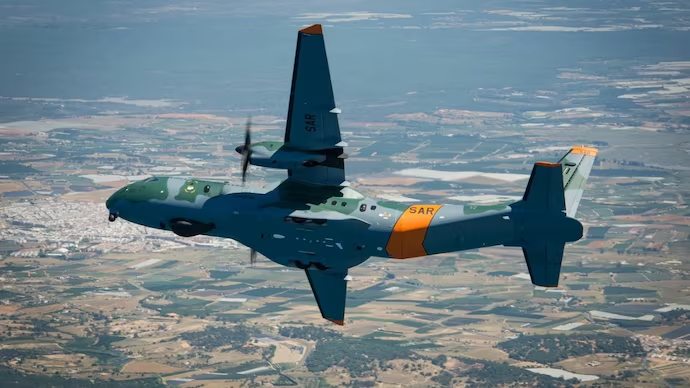
The aircraft’s early rollout signals that the project is progressing ahead of its original timeline. Deputy Chief of the Air Staff, Air Marshal AK Bharti, visited the Final Assembly Line (FAL) in Harni, Vadodara, to inspect the aircraft as it prepares for its highly anticipated maiden flight.
ALSO READ : The ‘Dhurandhar’ Frenzy: Ranveer Singh’s Sequel Claims No. 1 Spot and Triggers Netflix Server Glitch in Pakistan
Shattering a Decades-Old Monopoly
For over half a century, military aircraft manufacturing in India was the exclusive domain of the state-run giant, Hindustan Aeronautics Limited (HAL). The rollout of this C295 marks the first time a private Indian company has assembled a military aircraft on domestic soil, fundamentally altering the country’s defense industrial landscape.
The Final Assembly Line was jointly inaugurated by Prime Minister Narendra Modi and Spanish President Pedro Sánchez, establishing a state-of-the-art aerospace ecosystem capable of handling aircraft assembly, testing, and complex Maintenance, Repair, and Overhaul (MRO) operations.
The ₹21,935 Crore Deal: How the Fleet Shakes Out
In September 2021, the Indian Ministry of Defence signed a ₹21,935 crore ($3.5 billion) contract with Airbus Defence and Space to acquire 56 C295 transport aircraft to modernise the Indian Air Force (IAF) tactical fleet. India has become the largest customer for the C295 globally.
Total IAF C295 Order: 56 Aircraft
├── 16 Supplied "Fly-Away" from Seville, Spain (Deliveries wrapping up)
└── 40 Manufactured Domestically by TASL in Vadodara
      └── First India-built unit prepares for flight; full delivery by 2031
While the contract mandated a completion date for the first Indian-built aircraft by September, the advanced rollout proves the depth and capability of the newly established domestic supply chain. The remaining 39 aircraft will see their indigenous component content scale up significantly, jumping from 48% in the initial batches to nearly 78% by the end of the production run.
Why the C295 is an Operational Game-Changer for the IAF
The twin-engine turboprop C295 is engineered to replace the IAF’s ageing, 1960s-era Avro-748 fleet. It introduces massive tactical upgrades to India’s frontline logistics:
- Short Take-off and Landing (STOL): The C295 can take off and land on unpaved, semi-prepared surfaces and strips as short as 670 meters. This makes it extraordinarily effective for high-altitude, rugged border terrains like Leh-Ladakh, Jammu & Kashmir, and the Northeast.
- Rear Ramp Door: Unlike the side-door-only Avro-748, the C295 features a rear ramp that enables rapid paratrooper deployment and the easy loading/unloading of light artillery pieces and military vehicles.
- High Payload and Modern Tech: The aircraft can carry up to 9.5 tonnes of cargo, 71 fully equipped troops, or 50 paratroopers. Every single unit bound for the IAF is also equipped with a state-of-the-art, indigenously developed Electronic Warfare (EW) suite.
Building a Resilient Aerospace Ecosystem
The “Make in India” C295 project has successfully onboarded 37 Indian-based suppliers from both the public and private sectors, spreading high-precision manufacturing nodes across Vadodara, Hyderabad, Nagpur, and Bengaluru. The program is ultimately projected to generate over 10,000 direct and indirect medium-to-high-skill jobs, cementing India’s long-term capability to potentially export military aviation platforms to international buyers in the future.
Final Thoughts
The rollout of the first Made-in-India C295 is more than a success story for Tata and Airbus; it is proof of concept for India’s private defense manufacturing sector. By delivering a highly complex military transport aircraft ahead of schedule, India has demonstrated that it possesses the technological infrastructure and workforce to build world-class aerospace systems. As this bird takes to the skies for its maiden flight, it moves the nation a massive step closer toward true Aatmanirbhar Bharat (self-reliance) in defense.
Frequently Asked Questions (FAQs)
1. Where is the Made-in-India C295 aircraft being manufactured?
The aircraft is being assembled and manufactured at the Tata Advanced Systems Limited (TASL) Final Assembly Line facility located in Harni, Vadodara, Gujarat.
2. Which older aircraft fleet will the C295 replace in the Indian Air Force?
The C295 is directly replacing the IAF’s legacy Avro-748 transport fleet, which has been in active service since the 1960s.
3. How many C295 aircraft will be built entirely in India?
Out of the total 56 aircraft ordered under the contract, 40 units are being manufactured and assembled in India by Tata, while the first 16 were delivered directly from Airbus’s facility in Seville, Spain.
4. Can the C295 operate in difficult mountain terrains like Ladakh?
Yes. The C295 is specifically designed for tactical environments, possessing Short Take-off and Landing (STOL) capabilities that allow it to operate safely on short, rough, and high-altitude runways.
5. What is the timeline for delivering all 40 India-built aircraft?
Following the initial flight testing phase of the newly rolled-out unit, production will steadily scale up at the Vadodara plant to deliver all 40 domestically built aircraft to the IAF by August 2031.
- Prince George Poses in Sharp Suit for Official Birthday Photo as He Turns 13: Royal Lineage, Family Ties & Growing Future King Role
- Wetherspoons Issues Fourth Profit Warning in Seven Months as Rising Operating Costs and Shift in Consumer Spending Bite
- Our Hearts Are Crushed’: Hannah Rapp’s Violent Death Sparks Outpouring of Grief Across Sports World
- Former Southern Water Employees to Face Trial Over Alleged Cover-Up in Wastewater Testing; Ex-CEO Matthew Wright Named
- HMDA Launches Major Road Widening Drive: Key Corridors Around HITEC City, PVNR Expressway & KBR Park Set for Urgent Upgrades




 By
By




![Sun Pharma’s $11.75 Billion Organon Acquisition: A New Titan in the Top 25[2026]](https://sparkchronicle.com/wp-content/uploads/2026/04/Gemini_Generated_Image_hnub3xhnub3xhnub.png)