
Author: Lucky Brothers
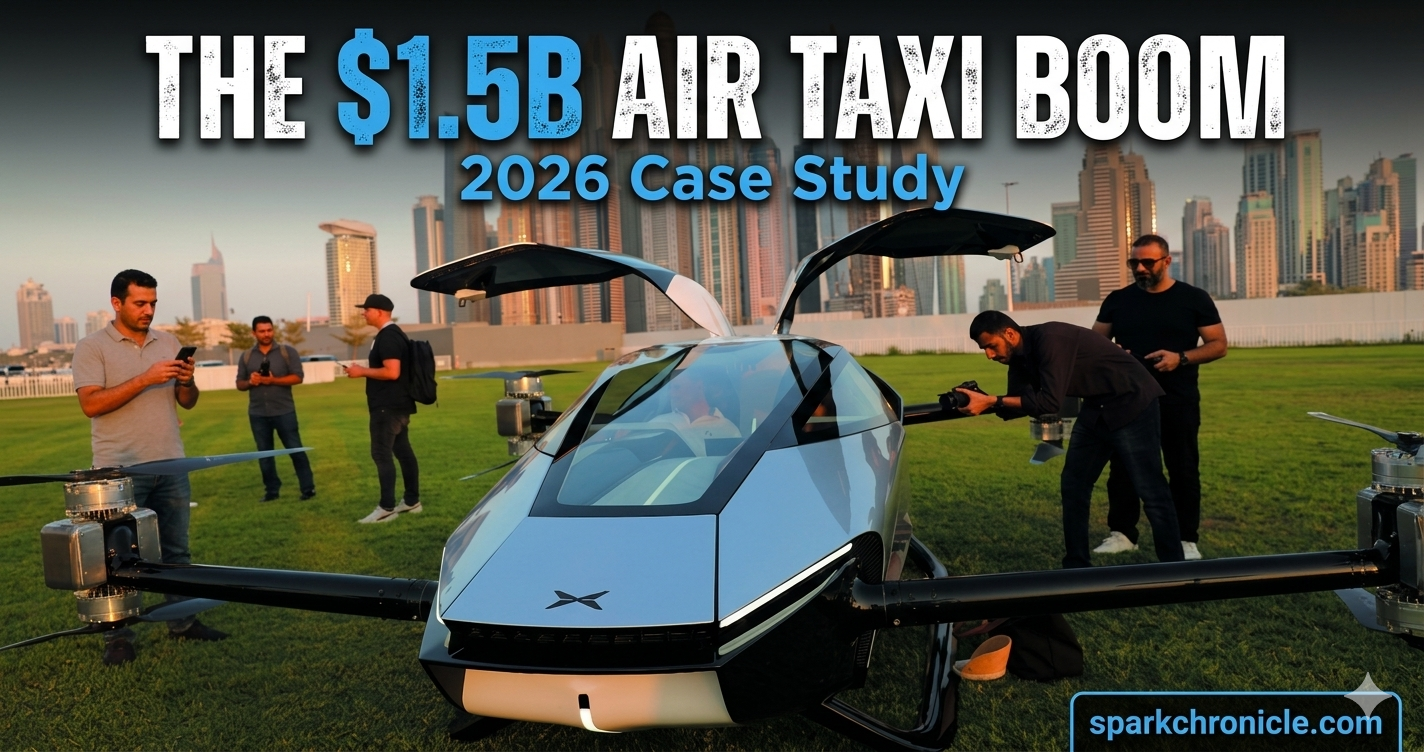
As we stand in April 2026, the concept of “flying taxis” has transitioned from the pages of science fiction to a multi-billion-dollar industrial reality. With major global cities facing peak-hour commute times exceeding 90 minutes, the push for Urban Air Mobility (UAM) has reached a fever pitch. This case study explores the technological breakthroughs, regulatory milestones, and infrastructure challenges of the electric Vertical Take-off and Landing (eVTOL) industry.
1. Executive Summary
The global eVTOL market is projected to be valued at approximately $1.4 billion in 2026, with a staggering compound annual growth rate (CAGR) of over 28% heading toward 2033. The industry is currently in its “Commercial Launch Phase,” with pilot programs active in major hubs like Dallas, Los Angeles, Dubai, and Singapore. The primary objective is to slash 45-minute ground commutes into 5-minute aerial “hops,” utilizing zero-emission, low-noise electric aircraft.

South Korean Stocks Top $4 Trillion in Market Cap for First Time
2. Technological Core: The eVTOL Architecture
Unlike traditional helicopters, flying taxis utilize Distributed Electric Propulsion (DEP). This technology uses multiple small rotors powered by electric motors, providing redundancy (safety) and significantly lower noise profiles.
Key Technical Specs (2026 Standards):
- Battery Density: Current lab-level breakthroughs have hit 450–500 Wh/kg, enabling ranges of 150–250 km on a single charge.
- Noise Profile: Flying taxis are approximately 65% quieter than traditional helicopters during cruise, making them socially acceptable for dense urban neighborhoods.
- Autonomous Evolution: While 2026 operations are primarily piloted, industry leaders like Wisk Aero and EHang are testing fully autonomous systems integrated with AI-driven conflict detection.
3. Regulatory Landscape: The “White House” & FAA Push
2026 marks a defining year for regulatory clarity. In the United States, the eVTOL Integration Pilot Program (eIPP)—backed by the White House—has selected partners like Joby Aviation to begin early operations across 10 states, including Texas, Florida, and New York.
- Type Certification: The FAA and EASA (Europe) have established clear certification pathways, treating eVTOLs as a new category of “Special Class” aircraft.
- Low-Altitude Economy: Countries like China have already codified laws (revised in 2025) to manage low-altitude airspace, providing a legal foundation for mass-scale logistics and passenger transport.
4. Infrastructure: The Rise of Vertiports
The “Powerhouse” bottleneck for flying taxis isn’t the plane; it’s the landing pad. Vertiports are being integrated into existing transport hubs.
- Retrofitting: Cities are converting the top floors of parking garages and rooftops of transit centers into charging and boarding zones.
- Public-Private Partnerships (PPPs): Over $2.1 billion has been invested in vertiport infrastructure globally through 2026, with a focus on high-speed, low-latency 5G/6G networks for real-time flight tracking.
5. Market Drivers & Economic Impact
- Urban Congestion: With 68% of the world’s population expected to live in cities by 2050, ground traffic is costing regional GDPs between 3–5% annually.
- Sustainability: Corporate net-zero mandates are driving executive travel toward zero-emission air taxis.
- Feeder Traffic: Airlines are using eVTOLs as “premium shuttles” to bring high-value passengers from city centers directly to airport gates, increasing passenger throughput by 40%.
6. Challenges & Roadblocks (The “Reality Check”)
Despite the optimism, the industry faces significant hurdles:
- Manufacturing Costs: A single eVTOL unit currently costs between $6.2M and $8.5M. Scaling to the $3M target is not expected until 2032.
- Public Perception: “Safety Anxiety” and “Noise Pollution” remain top concerns for residents living near planned flight paths.
- Supply Chain: The global lithium supply chain remains fragile, creating a 12–18% year-over-year cost volatility for battery production.
7. India Context: The Emerging Opportunity
In India, the Ministry of Civil Aviation (MoCA) has laid the groundwork via the Drone Rules 2021 and subsequent 2025 amendments.
- Target Cities: Bengaluru, Mumbai, and Delhi are prime candidates for eVTOL adoption due to extreme ground congestion.
- Barriers: High insurance costs, unclear business models, and the need for massive “Greenfield” infrastructure development in heritage-heavy city centers.
8. Conclusion & Future Outlook
The year 2026 will be remembered as the year the “Air Taxi” stopped being a gimmick. While full-scale mass adoption (thousands of vehicles) is likely a 2030s story, the current pilot programs are validating the demand and safety of the technology. From our perspective, the transition to the “Low-Altitude Economy” is inevitable. The “Powerhouse” cities of the future will not be defined by their roads, but by how effectively they utilize the three-dimensional space above them.
Author: Lucky Brothers
F.A.Q: Flying Taxi Case Study
1. How much will a flying taxi ride cost? Initially, prices will be comparable to a “premium executive chauffeur” service (roughly $100–$150 for a 15-minute hop). As per the reports, the goal is to bring this down to Uber Black prices by 2030.
2. Are they safe? Yes. eVTOLs are designed with High Redundancy. If one or even two motors fail, the remaining rotors are sufficient for a controlled, safe landing.
3. Will they fly in bad weather? Currently, most eVTOLs are restricted to “fair weather” operations. However, as per the sources, manufacturers are testing robust components to handle harsh winds and rain.
4. Who are the major players in 2026? Key leaders include Joby Aviation, Archer Aviation, EHang, Vertical Aerospace, and Lilium.
5. Is it really quiet? According to the reports, at a distance of 500 feet, an eVTOL sounds like a “light rustle of leaves” rather than the “thumping” of a traditional helicopter.
Final Thoughts
The flying taxi isn’t just about saving time; it’s about reclaiming it. As we see the first commercial passengers take flight this year, the dream of a “Jetsons-style” future is closer than ever. At Lucky Brothers, we believe the sky is no longer the limit—it’s the new highway.






 By
By![Sun Pharma’s $11.75 Billion Organon Acquisition: A New Titan in the Top 25[2026]](https://sparkchronicle.com/wp-content/uploads/2026/04/Gemini_Generated_Image_hnub3xhnub3xhnub.png)