
Author: Lucky Brothers
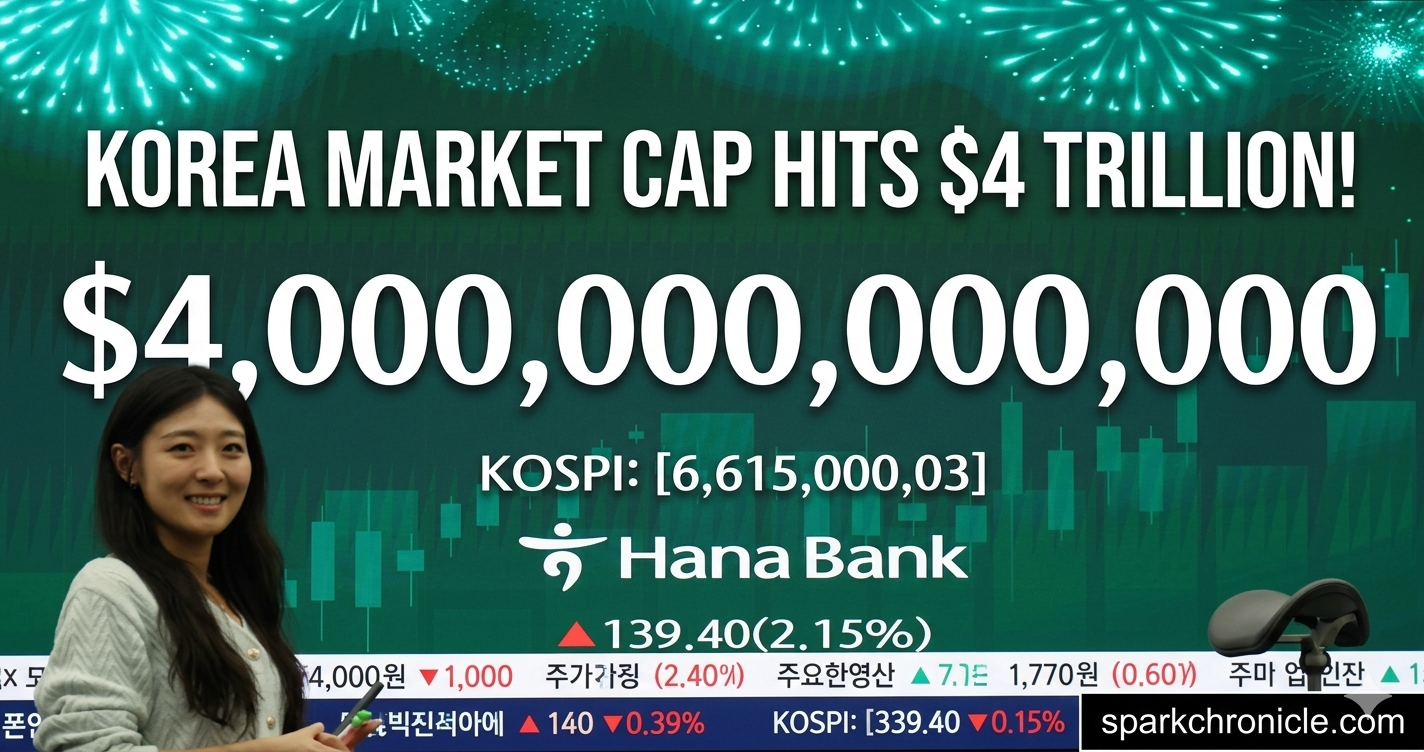
In a historic milestone for Asian financial markets, the total market capitalization of South Korea’s stock exchange has surpassed the $4 trillion mark (approximately 6,000 trillion won) for the first time in history. This breakthrough, recorded today, Monday, April 27, 2026, underscores the explosive growth of the nation’s technology and semiconductor sectors over the past year.
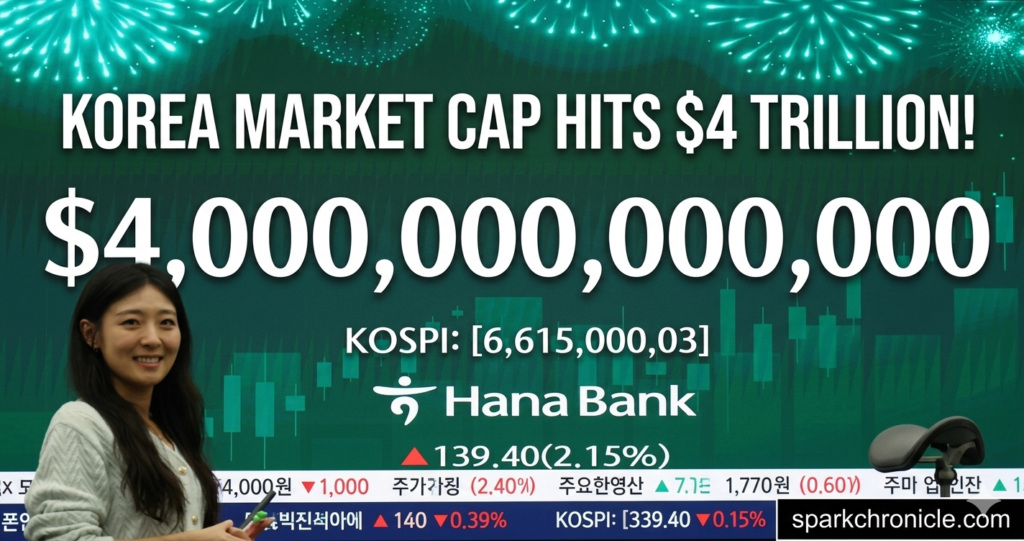
According to the reports from the Korea Exchange (KRX), the combined value of the three main bourses—the benchmark KOSPI, the secondary KOSDAQ, and the junior KONEX—reached a staggering 6,047.9 trillion won (roughly $4.1 trillion). From our perspective, this represents a nearly 2.7-fold expansion from the market’s low point just over a year ago.
ALSO READ

The Semiconductor Titans Lead the Charge
The primary engine behind this $4 trillion surge is the global AI “super-cycle.” South Korea’s semiconductor heavyweights have seen their valuations skyrocket as demand for high-speed memory chips reaches unprecedented levels.
- SK Hynix: The memory chipmaker has been the star performer, with its shares surging 5.73% today to close at an all-time high of 1,292,000 won. As per the sources, the company’s operating margins have hit record levels, driven by its leadership in High Bandwidth Memory (HBM).
- Samsung Electronics: The tech giant gained 2.28% to reach 224,500 won. Reports indicate that Samsung’s preliminary operating profit for the first quarter of 2026 alone surpassed its entire profit for the previous year, highlighting a massive turnaround in the chip sector.
- KOSPI Record: The benchmark KOSPI index itself hit a new historic close of 6,615.03, rising over 2% in a single session.
Beyond the Chips: A Broad-Based Rally
While semiconductors are the headline act, the rally has broadened into related high-tech industries. According to the sources, sectors such as power equipment, robotics, and autonomous driving are now contributing significantly to the market’s total value. Companies like LS Electric and Hyosung Heavy Industries saw double-digit jumps today, fueled by the massive infrastructure needs of global AI data centers.
In my opinion, the “Korea Discount”—a long-standing trend where South Korean stocks were undervalued compared to global peers—is rapidly disappearing. Foreign and institutional investors poured a net 2 trillion won into the market today, signaling a major shift in global confidence toward the Korean “Value-Up” corporate reforms.
F.A.Q: The $4 Trillion Milestone
1. Why did the market cap grow so fast in 2026? As per the reports, the growth has been exponential. The market hit 3,000 trillion won in July 2025, 4,000 trillion in January 2026, and has now jumped to 6,000 trillion won just months later. This is largely due to the AI-driven earnings boom in the chip sector.
2. Is the Korean Won strengthening as well? Yes. According to the latest data, the Korean currency strengthened by 12 won against the US dollar today, closing at 1,472.5. This currency strength often attracts more foreign investment into the stock market.
3. What are “Value-Up” reforms? These are government-led initiatives designed to encourage Korean companies to improve shareholder returns (like dividends and share buybacks) and increase transparency, making the market more attractive to international investors.
4. How does the KOSDAQ compare? While the KOSPI is the main board, the tech-heavy KOSDAQ also surged today, closing at 1,226.18—its highest level in years—driven by biotech and robotics stocks.
5. Are retail investors still buying? Interestingly, as per the sources, while foreign investors were buying heavily today, many local retail investors (known as “the ants”) were actually selling to take profits after the record-breaking run.
Final Thoughts
Crossing the $4 trillion threshold officially places South Korea among the world’s elite stock markets, currently ranking it as the 8th largest globally by market cap. From our perspective, this isn’t just a number; it’s a reflection of South Korea’s pivotal role in the future of global technology. As the AI revolution continues to reshape industries, the “Powerhouse” of Seoul is clearly leading the way.


- Prince George Poses in Sharp Suit for Official Birthday Photo as He Turns 13: Royal Lineage, Family Ties & Growing Future King Role
- Wetherspoons Issues Fourth Profit Warning in Seven Months as Rising Operating Costs and Shift in Consumer Spending Bite
- Our Hearts Are Crushed’: Hannah Rapp’s Violent Death Sparks Outpouring of Grief Across Sports World
- Former Southern Water Employees to Face Trial Over Alleged Cover-Up in Wastewater Testing; Ex-CEO Matthew Wright Named
- HMDA Launches Major Road Widening Drive: Key Corridors Around HITEC City, PVNR Expressway & KBR Park Set for Urgent Upgrades

 By
By


![Sun Pharma’s $11.75 Billion Organon Acquisition: A New Titan in the Top 25[2026]](https://sparkchronicle.com/wp-content/uploads/2026/04/Gemini_Generated_Image_hnub3xhnub3xhnub.png)